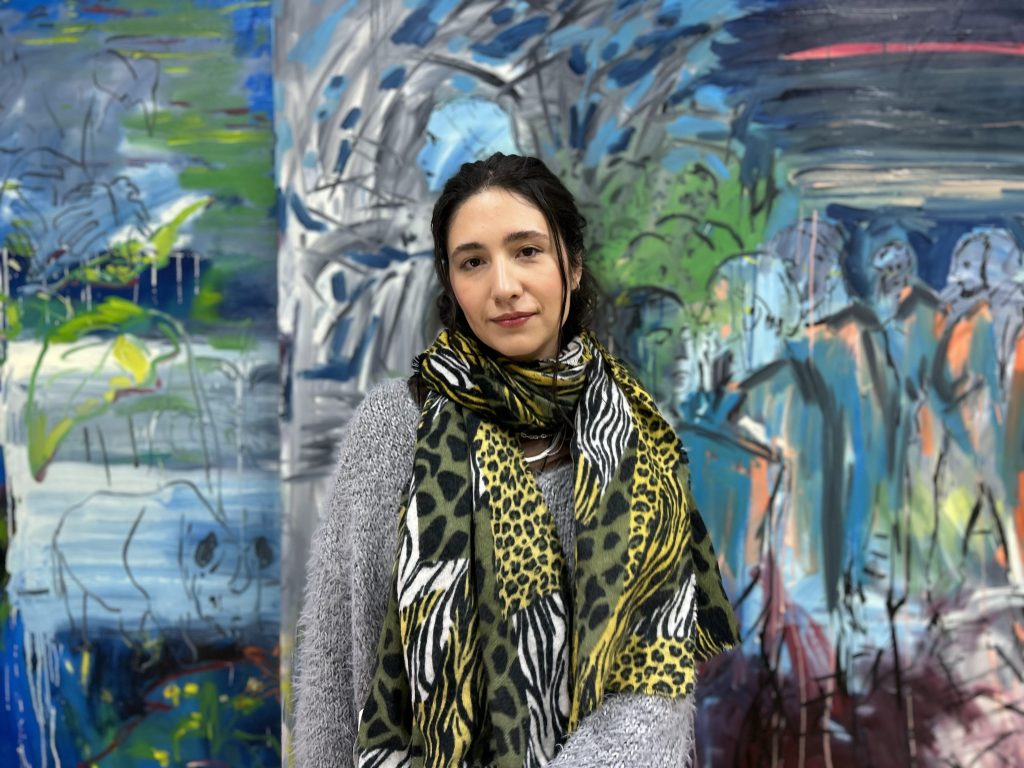
Donya Aalipour (b. 1995, Tehran, Iran) is a Vienna-based visual artist. She studied at the Academy of Fine Arts Vienna in the class of Daniel Richter. Her practice explores the intersections of personal memory, collective experience, and social reality. Working primarily through painting, she investigates how emotions, lived experiences, and political events become embedded in individual and collective bodies. Her works move fluidly between figuration and abstraction, creating spaces where narrative remains open and images resist fixed interpretation.
Aalipour’s practice is informed by an ongoing interest in the social role of art and the artist, drawing from both reality and fiction to examine the relationship between the individual and their surrounding world. Human relationships, vulnerability, resilience, attachment, and displacement recur throughout her work, often unfolding as interconnected visual narratives in which one image leads to the next. Through saturated fields of color, expressive lines, and layered compositions, she constructs emotional landscapes that oscillate between intimacy and tension, fragility and strength.
Growing up in Iran and later relocating to Vienna, Aalipour’s work has increasingly engaged with questions of memory, resistance, and collective agency. A recurring motif in her recent works is the dancing body. This interest emerged through reflections on the relationship between Henri Matisse’s Dance and Igor Stravinsky’s Le Sacre du Printemps, but gained deeper significance during the Woman, Life, Freedom movement following the killing of Mahsa Amini. Witnessing acts of dancing in the face of state violence transformed her understanding of dance from a symbol of celebration into a gesture of defiance, endurance, and collective resistance.
Drawing inspiration from contemporary visual culture, social media imagery, literature, museum collections, and observations of everyday life, Aalipour creates works that reflect on how individuals navigate systems of power, loss, hope, and belonging. Her paintings invite viewers into spaces where personal and political histories overlap, and where acts of remembrance become forms of resistance.

